

Structure, Working Principle and Key Features of Metallic Magnetic-Drive Pumps
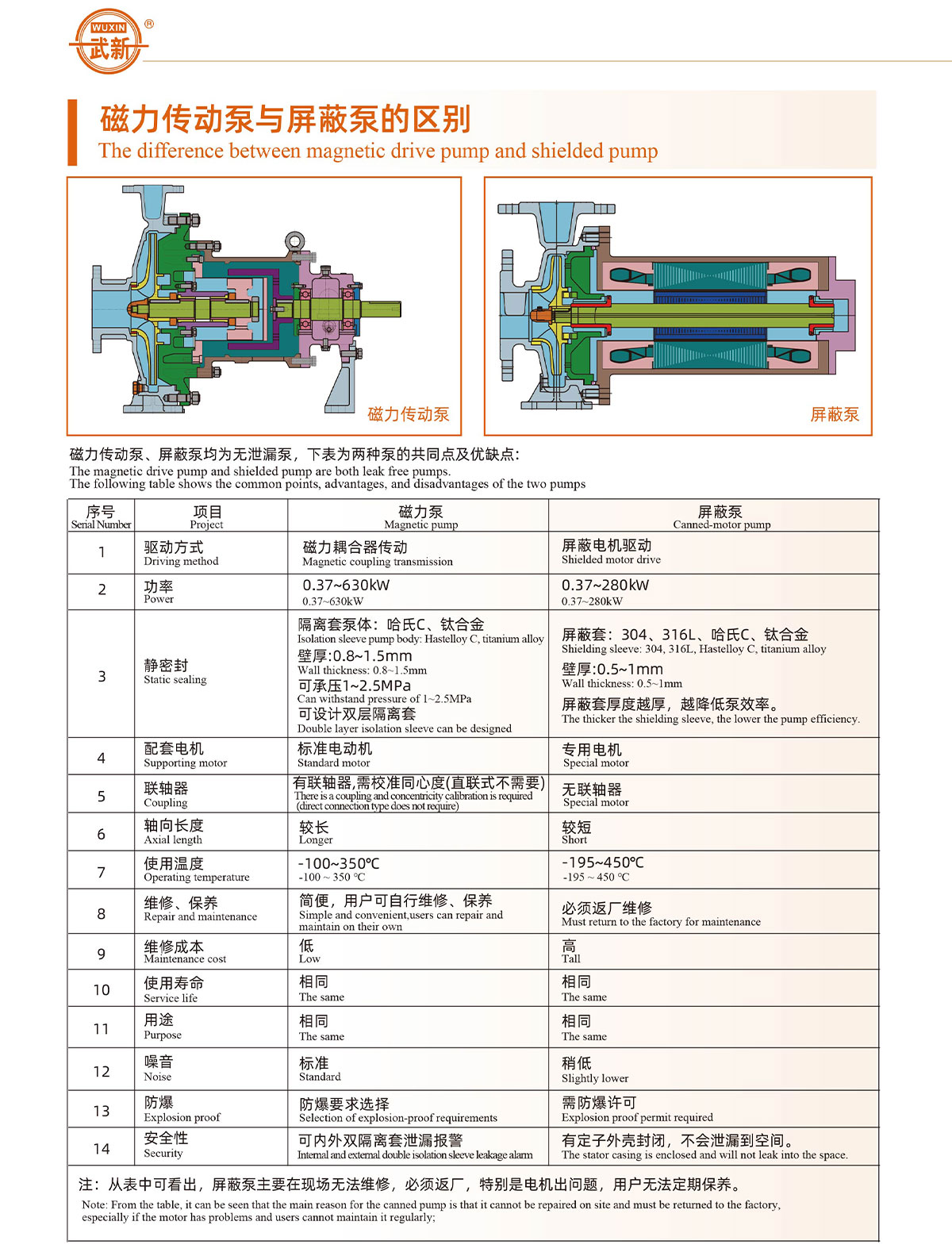
Structure: A magnetic-drive pump mainly consists of the pump casing, impeller, pump cover, shaft, bearing housing, shaft sleeve, sliding bearings, thrust bearings, non-magnetic containment shell, magnetic coupling with inner and outer magnetic rotors, bearing box, rear shaft, coupling, base and motor. Direct-coupled and integrated motor-pump designs are exceptions.
Working principle: When the motor drives the outer magnetic rotor, the magnetic field of the permanent magnets passes through the air gap between the inner and outer rotors and the non-magnetic containment shell. The outer rotor drives the inner rotor, impeller, shaft sleeve and thrust-bearing shaft to rotate synchronously, transferring power without contact. The medium is contained within a static sealing structure, which can reduce the running risks of splashing, dripping, leaking and escaping that may occur with conventional mechanical-seal pumps, while providing a static-seal effect comparable to that of canned-motor pumps.
Application areas of metallic magnetic-drive pumps include chemical processing, petroleum, natural-gas processing, coal chemical, chemical fiber, paper, metallurgy, defense, pharmaceutical, electroplating, electronics, semiconductor, food processing and environmental protection industries. They are used for media that may be flammable, explosive, volatile, toxic, corrosive or valuable, subject to duty review.
Pump selection should be based on the medium, temperature, duty conditions, flow, head and available NPSH. The matching pump type, wetted-part material and performance parameters should be checked against the applicable selection guide.
The pump unit uses a modular design with high parts commonality and interchangeability. Hydraulic components are referenced against domestic and international hydraulic models and optimized with computer-aided three-dimensional simulation; efficiency and anti-cavitation performance depend on the selected model and duty.
Core parts such as the inner magnetic rotor and non-magnetic containment shell use automated laser and high-frequency welding processes to support pump quality, efficiency and reliable operation.
Main wetted parts, including the casing, impeller and pump cover, are produced by silica-sol precision casting and then treated by pickling, passivation and polishing.
Intelligent remote-control operation can be adopted where the selected configuration supports it.
Detailed pump-selection performance data can be requested from the company in electronic manual form.
Return to News